
Abandoned Hotels of the Catskills Borscht Belt
 Show on map
By Jonathan H

Indoor Pool at Grossinger's
I had first read about the Catskills in an Art Spiegelman graphic novel. It was – perhaps satirically – depicted as a place of rest for the father in the story of Maus. The significance of the Catskills is not to be overlooked. Its history, its culture, and what it represents to our changing attitudes about the world, and our relationship with place — all of it could be made into a novel.
In fact, more than one novel has made its central subject the Castkill Mountains. It was the Borscht Belt. It was where Jewish Northeasterners sojourned. It was even where the Hudson School of Art began, and where Thomas Cole found his inspiration. What was its draw? What made it appealing to the rising class of Jewish immigrants who had finally achieved success in the shores of the Eastern Seaboard?

The Grossinger Terrace Room in its Hey-day
Today, such escapes can’t exist. They are no longer relevant, nor are they economically sustainable. When a JetBlue flight to Las Vegas costs about the same as a drive to the Mecca of early 20th-century Jewish leisure, one can easily assume that one or the other will fall by the way-side. Chances are, it’s the one that is closer to home that becomes disposable.
By the mid-90s, the vast majority of the 1100 Borscht Belt hotels had become history. Jerry Seinfeld, who was once a regular in the comedy clubs of the area’s resorts, had moved on to network TV. The areas of Sullivan County that were once the centerpiece of Jewish-American leisure could not compete with Florida, Hawaii, The Caribbean, or California.
It was at Grossinger’s Hotel that the very representation of this tragic loss became all-the-more-apparent. Today, the only thing being maintained on resort that dates back to the 19th century are the greens of the golf course. The sprawling complex of 35 buildings, 1200 acres, and once host to 150,000 guests a year, has become an eyesore of the past after closing in 1986.

The Outdoor Olympic Pool at Grossinger's in the 60s
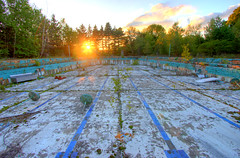
The Grossinger Outdoor Pool Today
There is no longer an active hotel; no outdoor olympic-size swimming facility; no lounge that hosts the high-dollar comedians of their day. There is only a 1/4-full green moss-ridden pool, surrounded by invasive indoor ferns. The burgundy and white tiles are merely a vestige. Fern and freezing-and-melting water become the centerpiece of a once-grand swimming facility. Only the lounge chairs remain as they were 20 years ago, when Grossinger’s had closed its doors once and for forever.

Maus, Catskills and Spiegelman
Reconstructing the Catskills
By Jonathan Haeber
Author & Photographer of this article
Paperback, 8″ x 7.5″, 60 pages, color photos
$20.00 — ISBN 978-0-9772742-8-4
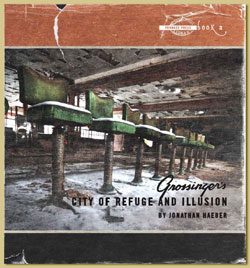
A poignant look at the most famous resort in the Catskills. A full narrative of the history of Grossinger’s as told through 26 vivid, color images and 8 short chapters. Learn about the importance and significance of this once-bustling, but now abandoned, Catskills institution. Learn More >>
I have always held a high reverence for the Catskills. Few people I know had heard of the place. Perhaps it was the single frame that Spiegelman sketched of the place that attracted my imagination. There was something in the fact that it was a destination of escapism, and it was also a place – fantastical as it had become – that was the very antithesis of the horrors and the atrocities of Nazi Germany.
Drawing from old postcards, and trying to reconstruct in my mind the joy and the memories of these Catskills is a poor substitute to actually being in the place at its ap0gee. My journey to these mountains was limited to a few hours – for my jet flight back to the West was leaving the following morning. But the few hours I was there bended my mind and fractured my own notion of any sort of dimension.
Deep under the boiler house of Grossinger’s, for example, one of the largest of the Borscht Belt resorts, I discovered an intricate system of man-made tunnels that snaked and kitty-cornered under the grand dining room of the hotel. It seemed to be a massive, underground refrigerator or cold-storage area, but it literally occupied a football field’s worth of underground space. Walls collapsed into each other. Ceilings succumbed to the enormous weight of the hotel above me. In certain places, the floors above me had turned into empty holes where one could stare high into the empty spaces of the higher floors after emerging from the dark recesses of the cavernous cold storage room underground.

The Hidden Tunnel at Grossinger's
Walking up to the remains of the skating rank, I encountered a left-behind pair of ice skates, children’s mittens, and a cap – all of which looked to be at least 25 years old. And in the grand wood-paneled lobby, I saw the opulence reduced to a decaying mess of soggy drywall and mossy cement.
Grossinger’s was certainly a headliner among the Catskills hotels, but the Tamarack Lodge came in as an interesting mid-tier alternative.
Experiencing Grossinger’s Hotel After its Decline
There is nothing that will ever match my experience at Grossinger’s. I’m sure that I will never again see anything quite like it. Ironically, these resorts declined as a result – in part because of the Civil Rights Act of 1964. Before the landmark declaration, many Jews were either implicitly or explicitly not allowed in upscale resorts outside of the Catskills. By the time this occurred, rail service began cutting service to the area, and the jet era was about to begin. A younger generation of Jews had chosen other destinations for vacationing, and the old generation found themselves largely retiring to Florida.
Video Documenting the End of the Catskills Era
And, as a final farewell, just this last spring one of the greatest hotels of the regions was demolished. The Concord was the largest hotel in the Borscht Belt region, and had closed after serving “sumptuous kosher dining” in its 3,000-seat dining room for five decades.Today, many hotels are slated to become Indian gaming casinos – ironically serving another culture just as they once had for half a century.

The Catskills Tamarack Lodge Pool
The Catskills may no longer attract sweeping artistic movements; these mountains my no longer be the sojourn of a post-WWII community battered by the horrrors of bigotry. Downtown, in Liberty, or East Falbrook, Kiamesha, or Bethel – you won’t see the glowing marquee of a matinee or the bright lights of kosher restaurants. But underneath the branches of pine and ash trees, you might just be walking on the old remains of a skating rink or olympic swimming pool. If you do, just imagine what it was like years ago, when this place was a seasonal escape from the crowded hustle of New York City.
 Reddit!
 Del.icio.us
 Digg
Digg StumbleUpon
 Technorati
 Blinklist
 Furl
Furl
oh, forgot, sorry, Also, Skopps Bungalow’s. Any info? thanks again.
Love reading all the article about the catskills Visiting was a big part of my childhood. We would visit the Melody Hotel for the entire summer. This was in 1950/60. I am ooking for any information about the Meloy sine then. Would you have an address. Last summer I took a ride Upstate NY and went on a hopeless goose chase. I ouldn’t fin the otel. Any information you cn supply would be greatly appreciated.
Thnnks for your help.
Kandi
There was a “melody country club” in Liberty, N.Y. Don’t know exact location, or if any of it is still standing, but you can check with visitor center or townhall etc in Liberty
Woodbine Hotel was in Ulster Heights. Since most old places are gone..destroyed, burned, torn down etc best to check with a town hall etc for
its original location. Definitely in Ulster Heights.
in the Catskills for summer vacation, since that is where my Grandpa Frank would go to play bocci ball and enjoy his summers. The resort was run by the Fonda Family, and it left me with indelible, fond memories. The resort was small relative to the giants like Grossinger’s, but it had a pool, nice little cabins, a nicve bocci ball court, and entertainment each evening. Great memories, and to this day, whenever I see black-eyed susan flowers, which were very abundant in the area of the resort, I think of those days with fondness.
Sorry, my previous comment was cut off. I said that my parents came from Italy, and when I was young, our family would spend summer vacations at Otis View Manor in the Catskills…..
What happened to the lebowitz Pine View hotel in south Fallsburg?
My understanding is that it is now a prison. By the way, I used to hang around the Pineview somewhere between 67 and 73. In fact one year I was the lifeguard during Labor day week.
I believe Marty is right.It became part of the Woodburn prison, probably as living quarters for guards.
I worked there as a busboy from 1974 to 1976. I also grew up in Woodbourne.
I love your blog. My parents honeymooned at The Concord in the early 1950’s. What an era!
Link below.
Thank you
Howard from Boston
http://gothamist.com/2016/10/10/borscht_belt_hotels_photos.php#photo-1
Here is a link to another great article.
http://gothamist.com/2016/10/10/borscht_belt_hotels_photos.php#photo-1
Where was Cedar Hill Lodge located? What is the property currently used for? Thanks!
Where was Cedar Hill Lodge located? What is the property currently used for?
Cedar Hill was in the Fallsburg/South Fallsburg area. probably nothing left to see as almost everything has been demolished
,
or in decay
My grandparents took me to a bungalow resort called Echo Lake Manor in the Catskills, South Fallsburg when I was a child. Does anyone know about this summer resort? Who owned it and when did it close?
not sure when it closed, but it was owned by the Grossman family
The Melody Country Club was up the road from Grossingers Hotel. Stayed there every summer from early 1950 to mid 1960. The swimming pool I learned to swim in is still there to this day and operational. It was operated by Brill & Gretenstein. When it closed it was turned into a summer camp for Hassidic Jews. The original hotel building still exists today. Tons of memories. Anyone else stay there. Watched Sputnick pass over the property with it’s blinking light. Fished at Neversink Reservoir. What a wonderful era.
My husband was at the Melody Country Club the same time as you. He is looking for someone to discuss this with. If you want to discuss this you can contact us at kgn272@aol.com or find me on Facebook
Would love to hear from you. Thanks. Kandi Cohen
I played in the band and waited tables at the Woodbine Hotel in Ulster Heights as a teen in 1969-70. Owners Harry and Betty Tenner and their manager (don’t recall her name) are a happy memory now!
Hi, Emma Joy Jampole?! Can you tell me where the woodbine hotel was located in ulster heights? thanks!
Some of you on this thread that are also on Facebook might be interested in joining the group called Catsills 1960’s and 70’s.
My grandparents were Izzy and Jenny Grossgold> They owned Grossgold’s Bungalows in South Fallsburg
They were near Kan Acres lake and Bungalows and the Blue Eagle, Pines, and Nemerson’s Hotels
We kids would sneak into the big hotels to use the pool and see the show.
My parents owned Smith ‘s Shoes in South Fallsburg
I remember your parents well—we opened Kosher socks in Trudy’s toy store in the summer of 1987—–32 years of watching the catskill change.
I remember smith shoes well—-and of course the big shaggy dog that would frighten the little chassidic kids and probably there mothers also. Your parents were/are wonderful people.
My ancestor Merchant Lawrence owned Lawrence Tavern there. We are in Australia, I wonder if there is anything left at the site as we may visit one day.
My ancestor Merchant Lawrence owned Lawrence Tavern there in the Catskills. We are in Australia, I wonder if there is anything left at the site as we may visit one day.
If you know what the address was or have a picture that would be helpful. I will ask my mother about it and some other people and let you know.
I can remember vacationing at a place called perhaps the Grandview? I only remember having to drive up a hill to get there and the sign was up on a hill. It was a motel with a good size pool and shuffleboard. Don’t remember too much as it was the late 50’s and early 60’s and I was 5 or less. I’m Italian and all my aunts, uncles, and cousins would go. We were one big, happy family. Wonderful memories of great food and my parents enjoying the evening entertainment. I remember older siblings having teenage crushes on the owner’s children who were our waiters. Remember my mother hanging clothes behind the motel and coming face-to-face with a mountain lion (or something like that…she was paralyzed with fear!)
My mother was a singer and dancer in 1950-1951 at Grossingers and The Nemerson Hotel. My biological father was her dancing partner. He and my mother are both deceased, and through Ancestry.com, I found out who he was and have found some family. However, because so much time has gone by, I can’t find anyone that can tie them together. I would be so grateful if by some chance, given their names, someone might remember them. Probably a shot in the dark, but worth a try for me.
does anyone rememberthe “AROUND THE CORNER BAR – LOUNGE ” across from the back door staff entrance to the CONCORD HOTEL?
To: Jeff Tieger
My parents were friends of your grandparents Izzy and Jenny Grossgold. We were at Grossgolds Bungalow Colony in the early 50s. There was no pool on the premises but there was a lake across the street that we used for swimming. Every day we stood by the chain link fence that was access to the lake until it was opened to us kids and our families.
need info on the Prospect hotel Swan Lake NY
does anyone have pictures of pine springs hotel from back in the 60s
I’ve heard of the Prospect Hotel. During the 50s, we stayed at the Commodore Hotel, right on Swan Lake, next to the Stevensville.
Anyone remember the Pine Grove House in Palenville? Met some one named Merry who’s Dad was a NYC cab driver and lived in Brooklyn by the Bay Ave exit of the Belt Parkway.
It was around 1963.
In response to the posting on October 24, 2017 at 1:44 am. I stayed at the echo lake manor bungalow colony back in the late 1960’s. I remember the owner’s first names. They were Sanford and Esther. They also ran the pleasant valley day camp which was on the premises.
I became nostalgic and decided to check on Blum’s Orchard Grove Hotel in the Catskills. My wonderful father paid to send my mom and sister and I there for the summer in the forties, to escape the Brooklyn heat. He came on weekends to be with us. Sarah Blum was the owner. Sarah was related to my father. I know no one will remember Blum’s but I am pleasured by writing this and remembering.
Luna Hannah, I think the Woodbine was on Ulster Heights Rd. I have a notion to drive there (I live in Illinois) one day and trying to find it – or whatever is there now. I had heard that it was sold and repurposed as a Kewoah children’s summer camp.
I did remember the manager’s name: Louise.
Emma Joy Jampole
Hi. Do you remember anything about the area to help locate it? I know there was a lake, but not sure which one??