
Kahuku Marconi Wireless Station, O’ahu, Hawaii
 Show on map
By Jonathan H
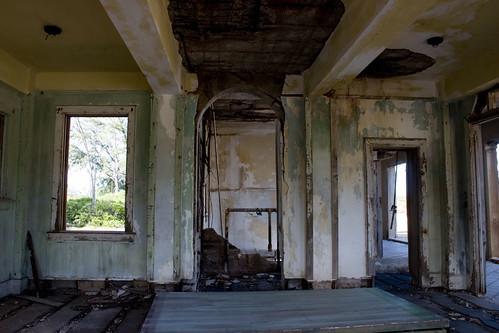
The Marconi Wireless Station at Kahuku on the North Shore of Oahu, Hawaii.
 Long ago, before my grandfather was born, a young Italian named Guglielmo Marconi developed a process of communicating without the aid of land-line telegraph cables. The birth of wireless telegraphy was embraced by the British during their Second Boer War, but the promise of communication across vast oceans between families and friends, businesses and diplomatic bureaus was where wireless truly shined.
I recently traveled to Hawaii to visit a friend (ostensibly), but also to explore the island’s many historical locations (I have my ulterior motives). Earlier, I had spoken of the abandoned sugar refinery on the North Shore and its incredible ties with bird guano (believe me, there’s a connection). In the future, I will talk about Battery Harlow in Diamond Head, a World War I-era array of guns designed to defend the new U.S. territory.
Most important, though, is this station on the North Shore (The Kahuku Marconi Station). In the details of this station, one can parse out a history and trace the root & origins of the Military-Industrial Complex. Today, parts of the station are occupied by a krill farm. The old powerhouse, which supplied the 300 kW towers with their much-needed electricity, is now full of temporary above-ground pools of growing shrimp (and large bull frogs, as well). The old “Hotel” as it was known (which often housed unmarried Marconi workers or visiting dignitaries including Jack London himself) is a crumbling and empty bone.

Image courtesy Library of Congress
If there is any place in Hawaii that desperately needs National Register status, it is this place. When World War II broke out, the Marconi wireless towers were no longer needed (long-wave radio transmission was a thing of the past), but the original line of towers was replaced by an airstrip that sent out cargo planes to their destinations across the Pacific Rim.
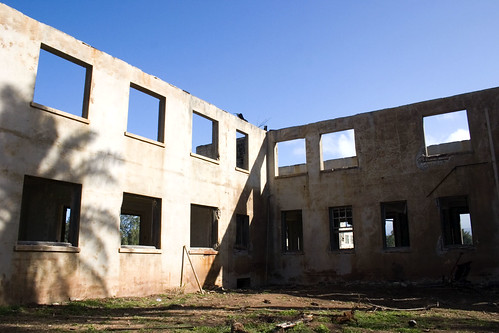
I visited the Kahuku Station during the day. The krill farm, though active, was eerily vacant of people. A gentle breeze — like any Hawaiian breeze, warm and humid — came in from the North. The palms danced to the cadence of the wind, which wound its way through the broken window frames of the Hotel. Krill pumps hummed, and I imagined how similar they sounded to the original transformers for the wireless towers.

Photo courtesy Library of Congress
The humidity has a different sort of effect on the plaster and paint of abandoned buildings. Living in California, it was a rare sort of sight for me to see. Each layer of paint peeled away to reveal an older, more colorul version of the wall. And the arched doorways and stairwells gave me an idea of its once grand design — despite the hotel’s utilitarian purpose.
I think the Kahuku Station and its related history deserve so much attention that — in the coming days — I will post a three-part entry on Wireless Telelgraphy during World War I. I hope you enjoy the history as much as I did. This is meant only as an introduction to a fascinating story about government, communication, corporations, and war.
 Reddit!
 Del.icio.us
 Digg
Digg StumbleUpon
 Technorati
 Blinklist
 Furl
Furl
Am the steward (voluntary) of the Radio Towers Property of the Sippican Lands Trust in Marion, Massachusetts. Radio Towers was once the Marconi Wireless transmitter site here. Much of the original Marconi era buildings have survived, as well as remnants of the 14 400 foot tall towers which supported the flat top antenna array at Marion. All that remains of the antenna are the tower foundations, the guy wire anchors (4 per antenna), and the 6 tuning coil bases. The field is overgrown now since the destruction of the towers in 1960, but the access road running the length of the field is still open. The Alexanderson Alternator at Haiku was transported from Marion during WW II.
Mr. Evans,
I would love to hear more about the Marion wireless station. My late grandfather Gerald J.C. Eshleman had links to both Kahuku as well as Marion & the wireless station in Tuckerton, NJ. In fact, I owe my very existence to the fact that my grandfather was sent to Kahuku by RCA in 1920 on temporary assignment to assist with installation of an Alexanderson Alternator there. At the time he as a 28 year old single man fresh back from Army service in WW1. Of course in those days the only way to get to Hawaii was by ocean liner. He sailed from San Francisco on the SS Matsonia. There was also a 25 year old single young lady from San Luis Obispo on board that same ship heading to Oahu to take up a teaching position at the Kahuku elementary school. And waddiya know, the two met on the ship or shortly after and fell in love! She quit her job to return to the mainland when my grandfather’s assignment in Kahuku was complete. They married & returned to NJ where my grandfather was engineer in charge of the Tuckerton Wireless station from 1920 until it was decommissioned in 1949. They had four children, one of whom was my late father. After Tuckerton was decommissioned in ’49 (and later dismantled in 1955), he was sent to the station in Marion, which by then had something to do with the Air Force, and finished his career there and retired in 1957 after 40 years service with RCA. During his retirement he lived in Pennsylvania and returned to Marion often & had a fishing boat there. He passed away at age 86 in 1978.
Please email be with any info you have on Marion, an especially if you find any reference to my grandfather.
Thanks!
Steve Eshleman
Peoria, AZ
Just want to check and see if this link still works. Am still the steward of the Marconi antenna site at Marion. The buildings here are still largely complete, the antennas are long gone, as at Kahuku, but their supports and guy wire anchors, etc. are still intact here. I conduct tours for the current owners, the Sippican Lands Trust here in Marion. We are still well familiar with the Eshleman name here. The Sippican Historical Society has some record of him, as well.
Hope you are well,
Dick
By the way, one of the Marion Alexanderson LF transmitters was secretly moved to Haiku, Oahu (near Kaneohe) during WW2 (1943) to communicate with submarines. It was installed in a volcano crater.
I’d like to see what those records have to say . I have a short clip of home movies on VHS of my grandfather out fishing on his boat off what looks like Marion, circa 1955. I am currently on my own boat near Pender Harbour on the Sunshine Coast of BC Canada.
I will dig around and see what I can find for you. They were news clips, I think. I have a fishing boat here in Marion, a 23 foot, center console rig.
We have a 1971 Albin 25 pocket trawler. Just got back to Pender Harbour from a 5 day run up Jervis Inlet to Chatterbox Falls at the head of Princess Louisa Inlet. 105 NM round trip on 8.2 gallons of diesel fuel.
My half brother Mike Eshleman works at the Pursuit Boats factory in Ft. Pierce, FL.
I HAVE A SERIES OF PHOTOS OF THE KAHUKU, HAWAII RELAY STATION WHICH MAY BE RESTORED IF FINANCIALLY POSSIBLE. LET ME KNOW IF YOU WOULD LIKE COPIES OF THESE PHOTOS TAKEN OVER THE PAST THREE YEARS.
Certainly would like to see copies of those photos. We did a NCL America cruise around the islands 10 years ago & got a pre-cruise bus tour of Oahu, but didn’t have the time or means to see Kahuku or tour the USS Missouri. Did tour the Punch Bowl cemetery & USS Arizona memorial though.
Hi there I am a local jewelry designer and would love yo do a photo shoot there. Is that something I could arrange, would I be able to get permission from you?
This is a great Historical site and historical evolution of communications. I came across the property for sale and it would be one hell of a historical monument restored.
During a recent visit with my elderly aunt in Florida (youngest daughter of my grandfather G.J. Eshleman )I recently came into possession (actually photographed with my smart phone), a treasure trove of photos of the Kahuku Wireless station taken by my grandfather, circa 1921 when he was sent there as construction superintendent by RCA to oversee installation of Alexanderson alternators & other upgrades. These photos include pictures of the outside of the plant as it looked then, plus a shot of the (huge) Alexanderson Alternator, a row of motor-generators, and condensers, and other unidentified transmitting equipment. Also some contemporary newspaper clippings which describe the cost ($1,000,000 in 1920s dollars) and time involved (8 months) in completing installations of “improvements” then being made to the station.
As mentioned in earlier posts this is where my grandparents met, and besides a collection of photos I also copied pages from a diary he kept, mostly talking about his activities during his spare time & courting my grandmother, but also a few mentions of things going on at the plant.
Please contact me directly by email ASAP and I can send you these photos.
If this system is still operating I’d like to add some information and ask some questions. I lived on Oahu from 1946 until 1959 and went to KHK while it was operating in either 1973 or 1977 and knew a relief operator there. There’s a lot to write about Hawaii radio but only if it’s sent to a live network. John, USMM Sparks K4XC
For Steve Eshelman: if you have not seen it already, look at http://jproc.ca/radiostor/aalt.html
It has a photograph and text describing your grandfather’s work at Marion, MA with regard to supporting the USAF arctic efforts.
I worked WCC on my first contact as a USMM sparks in Oct 1990. An FCC inspector was aboard my ship, appropriately, SS Cape Ann, just pulled out of the boneyard, and asked me to demonstrate the MF transmitter. I first called WLO, who would not talk to me unless I had traffic, so I then called WCC and said I wanted a signal report for the FCC inspector and they complied. That made WCC my favorite coast station for life.
I am particularly interested in the Marion Alexanderson alternators that were “secretly” moved to Haiku (which I’ve also been to). The “secret” would have been out the first time the station went on the air.