
Prisons & Geography: Past and Present
 Show on map
By Jonathan H
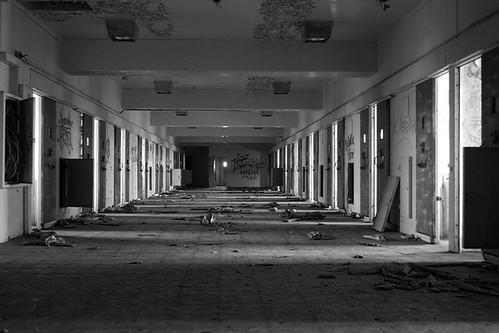
Cell Block “C” at the Fort Ord Stockade Confinement Facility. This abandoned prison was where the “Fort Ord 14” protested unfair treatment and poor prison conditions.
 While studying at Berkeley’s Geography Department, I had the unique privilege of taking classes from professors like Dick Walker and Ruthie Gilmore. Both focused much of their research on the geography of prisons in California.
What we have, most recently, is a boom in the country’s prison population. The top ten leading states in prison population — Texas, Florida, California, New York, Michigan, Georgia, Illinois, Ohio, Colorado, and Missouri — operated more than three times the amount of prisons in 2000 than they did in 1979.
And yet, the old aversion to prisons being built in communities is being replaced by a strong lobby for them. The Washington Post says, “Call it salvation through incarceration — a prison-based development strategy that small towns all over America are pursuing, and changing economically and culturally because of it.”
Or, consider the recent words of professor Allan Pred, who notes a rapid rise of a worldwide Gulag Archipelago set up by the CIA in countries around the world — from Jordan, to Syria, Thailand, Indonesia, even prisons based on battleships in the Indian Ocean. What he cites as a “torture by proxy” network of secret rendition areas in foreign lands — 12,500 “enemy combatants” rounded up, and disappearing with no record of their whereabouts.
Prisons, politics, geography, and economics mix up in quite a brew. Whether you’re on one side of the issue, or the other, there is no doubt that our prison population has dramatically increased.
Walking through the abandoned stockade confinement facility at Fort Ord reminded me of the past struggles of prisoners — many who were mistreated, many who were conscientious objectors and deserters from the Vietnam War. Its damp rooms of peeling paint are barely big enough to turn around in. Gravel pours in from all sides — it is now surrounded by a private sand and gravel operation.
I think of the moment in 1968, when the “Fort Ord 14” protested their treatment. For their peaceful protest they were nearly sentenced to hard labor and charges of mutiny. At the Presidio stockade to the North, there were as many as 60 suicide attempts for a population of 115. One prisoner, Richard “Rusty” Bunch was shot in the back of the head.
And in that empty prison, I hear those protest cries, still. Quiet, empty, full of detritus, but still resounding loudly with the voices of the past.
 Reddit!
 Del.icio.us
 Digg
Digg StumbleUpon
 Technorati
 Blinklist
 Furl
Furl
I was a guard there 1971-1973. played softball and basketball 54th mp’s post champs. anybody else out there that played?
I was at the stockade from 68 – 71, I took a few pictures of the hellhole several years ago if there’s any interest from people who stumble on this site. Email me or leave a message if interested in getting them.